
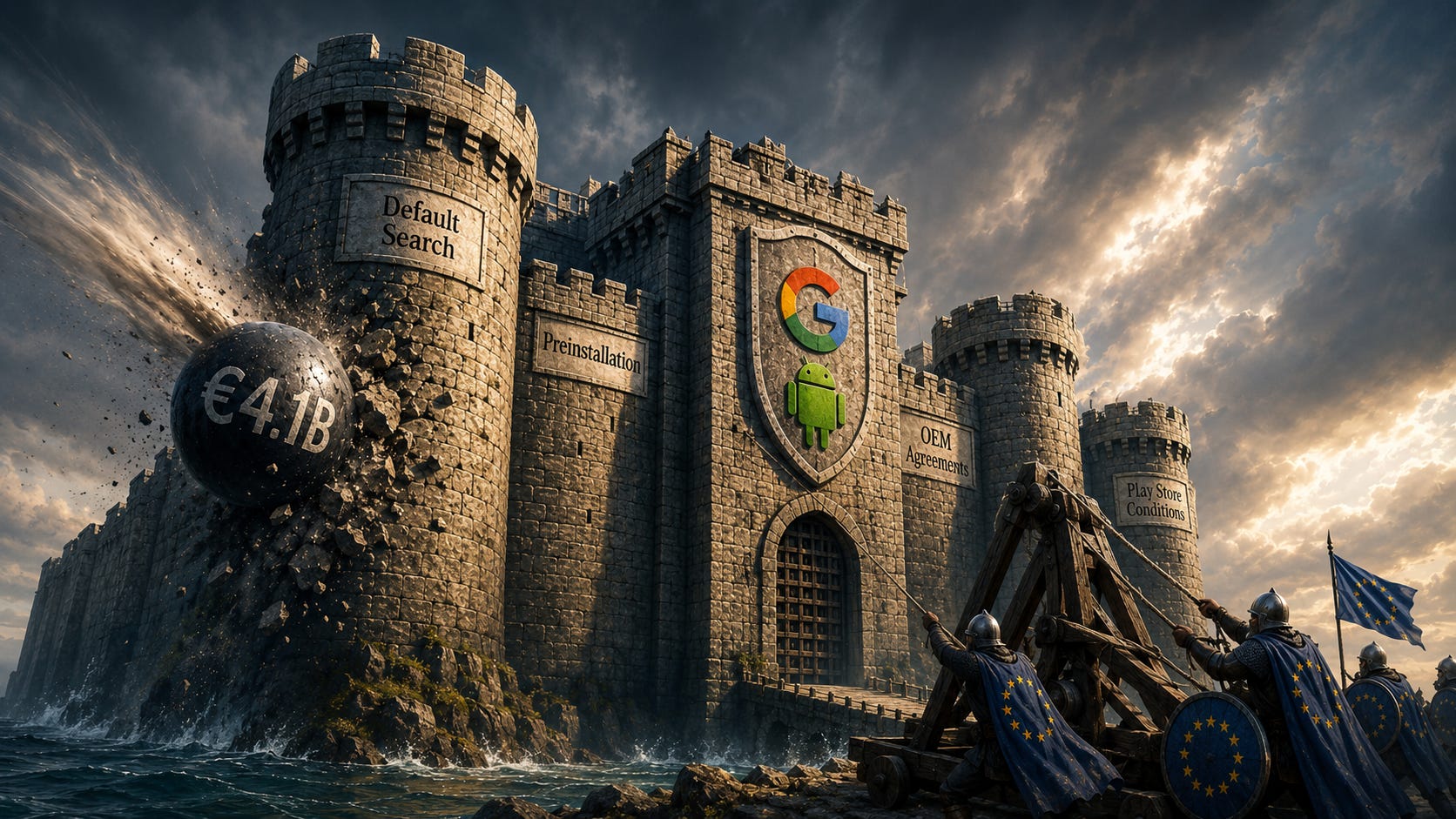
Everyone is going to read this as a story about a $1.5 billion verdict. It isn’t. It’s a story about whether Google’s abuse continued for longer than Google had claimed.
A Swedish court has ordered Google to pay PriceRunner 14.3 billion Swedish kronor, approximately $1.5 billion, after finding that Google’s preferential treatment of its own comparison-shopping service harmed the rival platform.
Including interest, PriceRunner’s owner Klarna (NYSE: KLAR) values the award at approximately $1.97 billion. It is the largest competition damages award issued by a Swedish court, although it remains far below the 78 billion kronor PriceRunner sought. Google disagrees with the ruling and is considering further legal action.
The judgment follows German decisions awarding approximately €465 million to Idealo and €107 million to Producto. The Berlin court found that Google abused its dominant position between 2008 and 2023, six years after Google says it changed the Shopping system to create fairer opportunities for competing comparison services. Google has said it will appeal.
Related claims remain active elsewhere in Europe, including proceedings involving Kelkoo and Foundem in Britain and a €2.97 billion claim from Moltiply Group in Italy.
The obvious conclusion is that Google faces an expanding damages bill.
That is true, but it misses the more important question.
Alphabet (NASDAQ: GOOGL) can absorb several billion dollars of litigation expense. It generated $73.3 billion in free cash flow during 2025 and ended the year with $126.8 billion in cash and marketable securities.
What becomes harder to absorb is a series of courts finding that Google’s 2017 remedy did not end the harm, particularly if those courts begin accepting a damages method other plaintiffs can reuse.
At that point, the problem stops being one judgment at a time.
It becomes a recurring challenge to the way Google controls retail search.
Base Case
Google will continue appealing the PriceRunner, Idealo and related damages cases, especially any ruling that extends the alleged harm beyond 2017 or gives other plaintiffs a reusable method for calculating losses.
At the same time, Google will become more willing to accept stricter rules governing how rival comparison-shopping services appear inside Google Shopping.
It may concede greater visibility, more transparent placement rules, outside monitoring and less discretion over participation. It will resist any remedy that breaks the direct route from a product search to a merchant inside Google’s own interface.
Google will give rivals better access to the Shopping machine before it gives up ownership of the machine.
What To Expect
Here is the stated position, not just the scenario: within the next 12 months, I think it is more likely than not that at least one higher court — German or British — either preserves a finding of post-2017 harm or accepts a damages methodology a different plaintiff can reuse without rebuilding it from scratch.
If that happens, the development that should change how investors price Alphabet’s ongoing litigation exposure is not the PriceRunner award. It is the existence of a second court willing to bless the same math. That is the event that converts this from a string of national verdicts into a template, and it is the one the market is currently underpricing relative to the headline damages figures.
I would be wrong if, instead, appellate courts in Germany or the UK narrow the damages window, reject the counterfactual growth methodology, or find that the 2017 remedy did in fact end the abuse. Any of those outcomes would support the “historical cleanup” reading rather than the “continuing exposure” one — and would mean this call should be revisited.
The Legal Event
The private cases grow out of the European Commission’s 2017 Google Shopping decision.
The Commission found that Google used its dominance in general search to give an illegal advantage to its own comparison-shopping service. It imposed a €2.42 billion fine after concluding that Google gave its own service prominent placement while rival comparison services were pushed lower in ordinary search results.
Google challenged that decision through the European courts.
On September 10, 2024, the Court of Justice of the European Union rejected Google’s final appeal and upheld the Commission’s finding that the preferential treatment of Google Shopping could constitute an abuse of dominance.
That decision substantially narrowed the battlefield for private plaintiffs.
PriceRunner, Idealo and the other comparison services do not have to begin by recreating the entire Commission case. Their litigation increasingly turns on different questions.
How much traffic did they lose?
How much revenue would that traffic have produced?
What would their businesses have looked like if Google had treated comparison services differently?
Most importantly, when did the harm end?
Google says its 2017 changes created fair opportunities for rivals. The German court’s decision to award damages through 2023 challenges that position. The Swedish ruling has also drawn attention for including periods after Google says it changed the system — the court found that “Google’s abuse continued for longer than Google had claimed”.
Even within a single ruling, courts are not applying a uniform clock. The Swedish court awarded damages covering roughly 15 years in the UK but only about 10 years in Sweden and Denmark — a sign that the boundaries of “when the harm ran” are still being negotiated jurisdiction by jurisdiction, not settled once and reused.
That distinction determines whether Google faces a finite historical liability or an exposure that continues growing.
Why the Judgment Is Not the Main Story
Nearly $2 billion would be meaningful to Klarna.
It is not enough by itself to force Alphabet to dismantle a profitable commercial system.
Alphabet’s financial position makes that clear. Google Search and Other advertising revenue reached $63.1 billion in the fourth quarter of 2025 alone, while retail was the largest contributor to growth across Search advertising verticals.
The pressure does not come from Google’s inability to pay.
It comes from repetition and transferability.
Google can manage several cases separately when every claimant must establish its own traffic history, conversion assumptions, commercial losses and hypothetical growth. The company can challenge each award, exploit differences among the plaintiffs and keep the claims divided among national legal systems.
The situation becomes more dangerous if courts begin converging on three conclusions:
Google’s 2017 changes did not end the commercial harm.
Lost traffic and profits can be reconstructed using a repeatable method.
Other comparison-shopping services can adapt that method to their own records.
At that point, Google no longer faces several disconnected lawsuits.
It faces the beginnings of a valuation system for more than a decade of lost business.
Google can absorb verdicts.
What it will not want is a formula.
The Economic Machine
Google Shopping should not be viewed as a small comparison website sitting inside Alphabet.
Its importance comes from where it sits in the commercial chain.
Before Google integrated product listings directly into Search, a consumer journey could look like this:
Consumer → Google Search → PriceRunner or Idealo → merchant
Google Shopping shortened the route:
Consumer → Google Search → merchant
Google controls the page where the consumer begins. It displays products, prices and retailers. It operates the advertising auction. It charges merchants for access to shoppers already approaching a purchase.
The independent comparison service is no longer required.
This matters because retail searches carry strong commercial intent. A person looking for a particular television, laptop or pair of shoes is closer to spending money than someone making a general informational query.
Google can convert that intent directly into advertising revenue.
Alphabet does not disclose Google Shopping as a separate revenue line, so there is no reliable public figure for its standalone profit. The broader importance of retail search is easier to establish. Alphabet identified retail as one of the largest contributors to Search advertising growth throughout 2025 and the largest contributor during the fourth quarter.
The disputed conduct was therefore valuable for more than the revenue produced by one Shopping product.
It helped Google preserve its position between the consumer and the merchant.
The exact conduct condemned in the original case may no longer be necessary to preserve most of that value. Google now possesses direct merchant feeds, enormous quantities of product information, established advertiser relationships, automated bidding systems and the ability to place commercial recommendations inside AI-assisted Search.
The machine has grown beyond the tactic that helped establish it.
That gives Google room to concede more than it did in 2017 without surrendering the underlying business.
The 2017 Problem
After the Commission’s decision, Google created a system that allowed competing comparison-shopping services to participate in Shopping placements.
Google argues that the change restored competition. It says the number of rival comparison services using the Shopping Unit increased substantially after the change.
The plaintiffs argue that the remedy preserved Google’s core advantage.
Rivals could participate, but only by entering an auction designed and controlled by Google. Instead of restoring comparison-shopping companies as independent destinations, the revised system incorporated them as participants inside Google’s commercial interface.
Google still owned the page.
Google still controlled the auction.
Google still maintained the direct relationship with merchants.
That distinction now sits near the center of the private damages litigation.
If the 2017 remedy ended the abuse, Google’s exposure becomes a historical cleanup exercise. The company can contest the awards, settle selected claims and allow weaker cases to lose momentum.
If the remedy did not end the abuse, the economics change.
Existing plaintiffs can claim more years of damages. New claims become more attractive. Regulators gain a reason to revisit the remedy itself. Each new Shopping format creates another possible dispute over whether Google has changed the appearance of the system without changing who controls it.
Historical exposure can eventually be priced.
Continuing exposure keeps growing.
Why Google Will Keep Litigating
An appeal is not merely an attempt to avoid paying PriceRunner or Idealo.
Google has several reasons to keep fighting even if it expects to pay something eventually.
The awards are provisional
PriceRunner and Idealo each recovered far less than they demanded.
PriceRunner sought approximately 78 billion kronor and received 14.3 billion kronor before interest. Idealo sought roughly €3.3 billion and received approximately €465 million including interest.
That gives Google room to argue that the headline numbers overstate its ultimate exposure.
A higher court could shorten the damages period, reject part of the hypothetical growth model, alter the treatment of interest or require stronger proof of causation.
Even a partial appellate victory would matter.
If a large trial award is reduced substantially, Google gains a lower public reference point for every settlement discussion that follows.
The methodology matters more than one award
The German court reconstructed a counterfactual world in which Google had not favored its own service. Commentary on the judgment describes a model drawing on Idealo’s historical traffic and wider e-commerce growth to estimate how the business might have developed without Google’s conduct.
Google will want to prevent that reasoning from becoming portable.
The danger is not merely that Idealo retains €465 million.
It is that another claimant can take the same structure and insert its own traffic history, geographic reach and conversion assumptions.
The post-2017 period must be contested
Google’s current defense depends heavily on the proposition that the original abuse ended when it changed the Shopping system.
A final ruling rejecting that defense would do more than increase one award. It would weaken Google’s position across the remaining cases and strengthen demands for another redesign.
Delay preserves fragmentation
Appeals postpone payment and prevent lower-court judgments from immediately becoming settled valuation anchors.
They also impose costs on the plaintiffs. Each claimant must continue funding lawyers, experts and years of litigation without certainty that the trial award will survive.
Google has repeatedly shown that it will pursue strategically important competition cases through the highest available courts.
The original Shopping dispute lasted until the Court of Justice ruled in September 2024. Google also continued challenging the separate Android decision until the EU’s highest court dismissed its final appeal on July 2, 2026, confirming the €4.125 billion fine.
There is little reason to expect a quick capitulation here.
Google Has Settled Major Cases Before
Google is not categorically opposed to settlements.
It has paid large sums and accepted operating restrictions when the agreement could purchase something concrete: defined closure.
Google Play
Google agreed to a $700 million settlement with a coalition of state attorneys general over the Google Play Store.
The agreement allocated $630 million to consumers and $70 million to the states while requiring changes to Android app distribution and in-app payment practices. All 50 states, the District of Columbia, Puerto Rico and the Virgin Islands joined the suit, giving Google an organized counterparty and a defined population of claims.
The structure mattered as much as the amount.
Google did not have to negotiate individually with millions of consumers. It paid into one process that could distribute compensation and resolve the participating states’ claims.
Google knew what it was buying.
French advertising technology
In 2021, Google settled a French competition investigation involving its advertising technology.
The French Competition Authority imposed a €220 million fine after finding that Google favored its own advertising services. Google did not contest the facts and offered commitments intended to improve interoperability with competing systems.
Again, the counterparty could deliver a defined result.
The regulator could accept Google’s commitments, make them binding and close the proceeding.
French publisher negotiations
Google also accepted a framework governing negotiations with French publishers and news agencies.
That agreement did not resolve every publisher claim with one payment. Instead, it created machinery for repeated negotiations, including information requirements and oversight intended to improve the bargaining process.
The experience also shows the limits of behavioral settlements — and it shows them twice. The French authority first fined Google €500 million in 2021 for failing to negotiate with publishers in good faith, then returned in March 2024 with a second €250 million fine for breaching the 2022 commitments that were supposed to fix the first problem, accepting additional corrective measures through a settlement procedure.
Google will accept operating restrictions when the pressure is sufficient.
It may also continue testing the boundaries after accepting them — twice, in this case, on the same underlying dispute.
Why the Shopping Cases Are Different
The Shopping plaintiffs cannot presently offer the type of closure Google obtained in those settlements.
There is no coalition equivalent to the U.S. state attorneys general.
There is no single European court administering every private damages claim.
There is no claimant body with authority to negotiate for PriceRunner, Idealo, Producto, Kelkoo, Foundem, Moltiply and every other affected comparison service.
The claims also differ materially.
Each company has its own traffic history, geographic reach, conversion assumptions, growth trajectory, damages period and national procedural rules.
A settlement with PriceRunner would not release Idealo.
A settlement with Idealo would not end the proceedings in Britain or Italy.
Even a final Swedish judgment may not dictate how a German, British or Italian court values a different company.
Google therefore has little incentive to announce a public Europe-wide compensation program.
It would risk creating a common price without receiving common peace.
The More Likely Settlement Strategy
The absence of a Europe-wide settlement does not mean Google will litigate every claim to final judgment.
The more realistic strategy is selective containment.
Google can keep appealing legal questions that affect the entire group of claims while settling particular cases that present unusually dangerous facts.
A settlement candidate would likely combine several features:
extensive historical traffic records
a favorable national forum
a large potential recovery
credible evidence of post-2017 harm
an appellate path capable of producing precedent other plaintiffs could reuse
A weaker plaintiff may be forced to litigate for years.
Any settlement would likely be confidential and claimant-specific. Google would have a strong incentive to prevent outsiders from calculating a simple payment per lost click, year or percentage point of market share.
Internally, however, Google could still create a common valuation matrix.
It could assess proven traffic loss, conversion assumptions, jurisdiction, duration, interest, post-2017 evidence and the probability that a case creates reusable precedent.
From the outside, the resolutions would look separate.
Inside Google, they could form a controlled runoff.
That would allow the company to remove its most dangerous cases without declaring that every comparison-shopping claimant has the same value.
What Google Can Realistically Concede
Google does not have to choose between changing nothing and dismantling Google Shopping.
There is a wide middle ground.
Google could accept:
independently verifiable ranking and eligibility standards
clearer disclosure of how rival comparison services obtain placement
limits on changes that disadvantage rivals after they enter
outside technical monitoring
greater access to performance information
more comparable treatment between Google’s service and competing services
measurable standards for visibility or participation
These measures would increase compliance costs and reduce some of Google’s discretion.
They would not necessarily break the commercial machine.
Google would still own the search interface. Merchants would still submit product feeds. Google would still run the advertising auction. Users could still move directly from Google to the retailer.
Rivals would compete for access inside the system rather than rebuilding themselves as independent gateways outside it.
That is the compromise Google is most likely to accept.
What Google Will Resist
Google will fight much harder against remedies that change who controls the consumer’s route to the merchant.
That includes measures that would:
remove Google Shopping units from valuable search positions
require Google to send consumers first to independent comparison sites
prohibit Google from displaying its own product-comparison results
separate the Shopping auction from Google Search
prevent Google from charging merchants for product traffic
restrict Google from integrating product recommendations into AI-generated answers
Those remedies would reach beyond nondiscrimination.
They would weaken Google’s ability to convert retail-search intent into a direct advertising relationship.
That is the line Google will try to hold.
The Pressure Map
Google retains substantial advantages.
It can finance long appeals. The claims are fragmented. The damages models are complex. Different plaintiffs may make overlapping claims about the same consumers and commercial growth.
Google’s weakness is the period after 2017.
If several courts agree that its remedy failed, the company will find it harder to describe the litigation as historical cleanup.
PriceRunner
PriceRunner has obtained a large judgment, but it still needs that judgment to survive appeal.
Its most valuable victory may not be keeping every krona.
A durable ruling accepting its theory of continued harm and explaining how to calculate the loss could materially strengthen the position of every remaining claimant.
Klarna
The award is a potentially meaningful legal asset for Klarna (NYSE: KLAR), but it is not equivalent to immediate cash.
Google may appeal, payment could be delayed and portions of the recovery may be owed to former PriceRunner stakeholders, litigation funders and tax authorities.
The judgment should therefore be viewed as a contingent legal asset rather than ordinary operating income.
Idealo and the remaining plaintiffs
Every ruling supplies information.
Plaintiffs learn which records matter, which assumptions courts accept and how judges view the post-2017 system.
Their collective weakness remains coordination. Google can continue exploiting factual and procedural differences unless a higher court supplies a common framework.
European regulators
Regulators may eventually determine the behavioral side of the dispute.
Private plaintiffs can recover damages. They are less capable of designing one Europe-wide operating framework for Google Shopping.
A regulatory intervention could impose common transparency, access and monitoring requirements. It would not resolve the private claims, but it could establish when the disputed conduct finally ended.
What to Watch: A Three-Tier Scorecard
Rather than tracking confidence up or down in isolation, the cleanest way to monitor this thesis is by tier. Each tier represents a materially different world for Google’s Shopping business.
Tier 1 — Confirms the base case (litigate the past, narrow the future)
Google’s appeals concentrate heavily on the post-2017 damages period
Google changes Shopping access or transparency rules while continuing to contest the judgments
regulators begin considering outside monitoring or measurable neutrality standards
a higher court preserves the finding of harm but reduces the damages calculation
Google confidentially resolves one particularly dangerous claimant while continuing to fight the others
Tier 2 — Complicates the base case (dispute outgrowing a limited fix)
Google refuses further behavioral changes despite repeated findings of post-2017 harm
regulators demand structural separation rather than access rules
courts conclude that equal treatment is impossible while Google controls both the platform and its own Shopping product
Google announces a broad multi-claimant settlement before exhausting major appeals
Google materially reduces the prominence of its own Shopping interface in Europe
Tier 3 — Refutes the base case (Google surrenders control of the route to the merchant)
users are meaningfully redirected through independent comparison-shopping platforms
the Shopping auction is separated from Google Search
Google is prohibited from integrating its own commercial comparison results into prominent search positions
independent services regain control over the consumer relationship rather than receiving access inside Google’s interface
The distance between the tiers matters more than any single data point. Better ranking rules, more disclosure and outside monitoring — Tier 1 territory — would constrain Google without altering the economic architecture. Only Tier 3 would.
The AI Search Problem
There is one further complication.
The original Google Shopping case arose from a search page built around links, advertisements and product boxes.
Product discovery is increasingly moving toward AI-generated responses.
A consumer may ask Google to identify the best television under a certain price, compare several models and recommend a retailer without visiting an independent comparison site.
Google could therefore give rival services fairer access to the existing Shopping unit while moving more valuable activity into an AI interface it controls.
That possibility changes what investors and competitors should monitor.
Future remedies may need to address not only traditional Shopping placements but also:
AI product recommendations
shopping summaries
merchant rankings inside generated answers
access to product data
the sources Google uses to construct comparisons
A remedy aimed at the old interface could arrive after the economic machine has moved somewhere else.
What Comes Next
The immediate development is Google’s appeal strategy.
An attack focused primarily on the size of the award would suggest that Google believes the conduct issue can be contained.
A concentrated challenge to post-2017 damages would show that continuing exposure is the more serious concern.
The German proceedings also deserve close attention.
The important question is not merely whether Idealo keeps €465 million. It is whether a higher court accepts a method other plaintiffs can reuse.
The first claimant to obtain a durable high-court ruling on both post-2017 harm and damages methodology could materially change the economics of every remaining case.
Google would still possess the resources to fight.
It would have less reason to believe the claims could remain isolated.
The Bottom Line
The market will focus on whether Google ultimately pays PriceRunner nearly $2 billion.
That is not the most consequential wager.
Google can absorb a large judgment. It can settle selected plaintiffs. It can spend years contesting damages assumptions.
The more important question is what the company must change to prevent the judgments from repeating.
The base case is that Google eventually concedes more transparency, outside oversight and meaningful access for rival comparison-shopping services. It will do so while continuing to appeal the damages cases and denying that its existing system remained unlawful.
Those concessions will be designed around one boundary.
Google will protect its ability to turn a product search into a direct relationship among its own interface, the merchant and the advertising auction.
The rivals may gain better access.
Google will try to ensure that the consumer still never has to leave its machine.
Within 12 months, watch for whether a German or British appellate court blesses either continued post-2017 harm or a reusable damages methodology. That is the event to price, not the PriceRunner number. If it happens, expect the base case above to accelerate. If courts instead narrow the damages window or credit the 2017 remedy, this call is wrong, and the “historical cleanup” reading takes over.
Editorial note: This article presents a probabilistic interpretation of litigation, regulatory and commercial incentives based on publicly available information. The confidence level applies only to the behavioral scenario described above. It is not a prediction of any company’s share price, financial performance or final court result, and it is not legal, financial or investment advice. Litigation, appeals, settlements and regulatory actions remain uncertain, and new facts could materially change the analysis.