

Markets love a settlement.
It turns fog into a number. It gives analysts something to model, investors something to stop worrying about, and management something to call “behind us” on the next earnings call.
That is the current narrative on the latest pharmacy benefit manager settlements.
Express Scripts has settled with the FTC over insulin pricing allegations. CVS Caremark has reached a proposed settlement. OptumRx has moved toward one as well. For investors, that can look like the big Pharmacy Benefit Manager (PBM) legal cloud finally starting to break.
Maybe it is.
Or maybe the storm just found a new route.
A settlement can end one case while making the next one easier to bring. It can show later plaintiffs what conduct mattered, what documents to ask for, what remedies regulators accepted, and where the money moved.
That is the underrated PBM risk now.
The market may be treating settlement as closure. States, employers, private plaintiffs, and a future administration may treat it as a handoff.
What to Watch
First, watch whether PBM scrutiny moves from Washington headlines into employer contracts, state subpoenas, ERISA lawsuits, and pharmacy ownership fights.
That is where the risk starts to look less like politics and more like money.
The first FTC case was about insulin, but the larger question is not limited to insulin. It is whether the same pressure points can be used against the broader PBM model.
That is what makes PBMs hard to value from the outside.
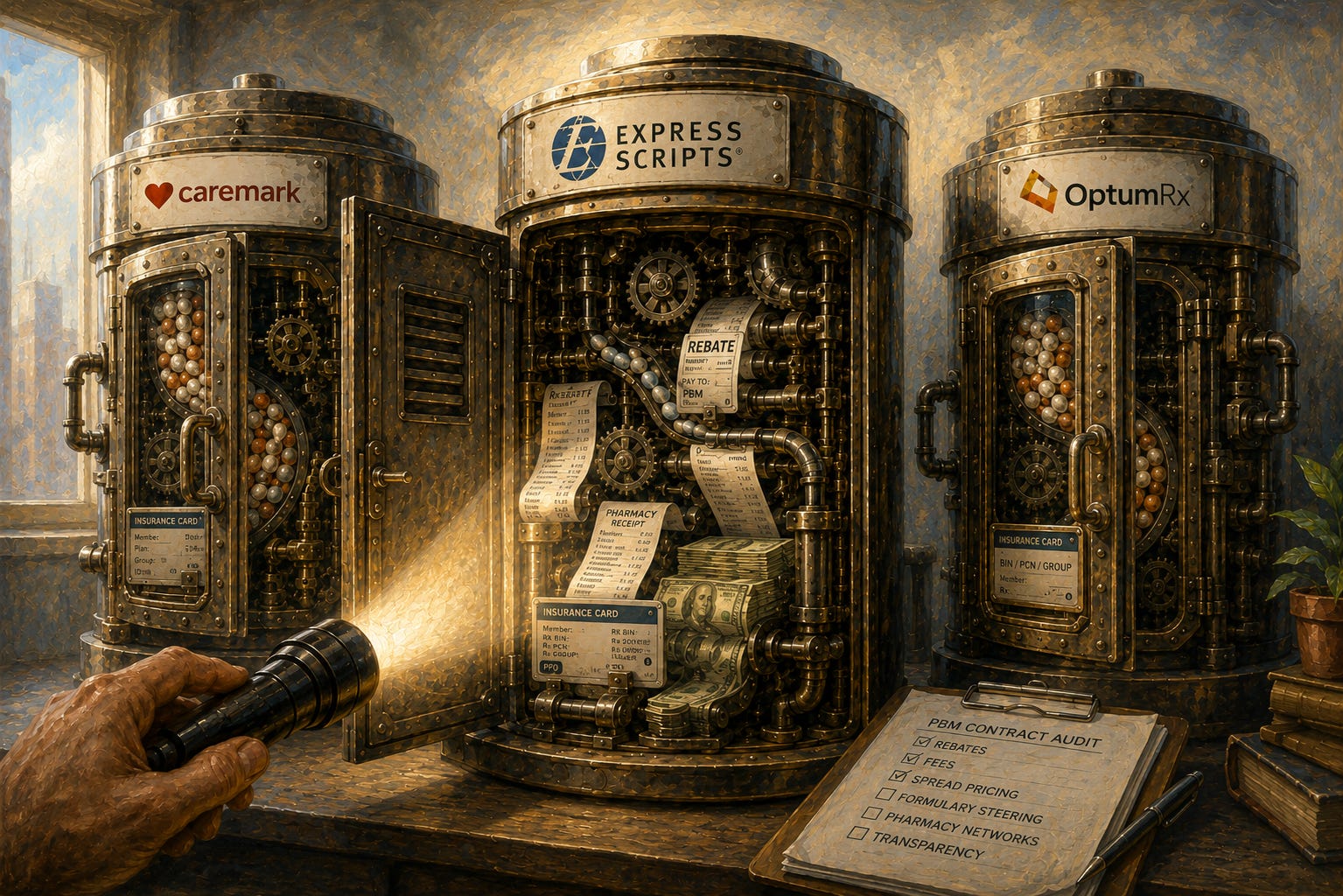
The money does not move in one simple line. It moves through rebates, fees, spreads, reimbursement rates, pharmacy networks, specialty dispensing, mail-order volume, audit rights, and contract language that most patients and investors never see.
Opacity is not a side issue.
It is the machine.
That does not mean every PBM practice is illegal. Nor does it mean the companies cannot defend themselves. It does mean investors should be careful about treating the FTC settlements as the end of the story.
The better question is whether the settlements make the PBM business easier for others to attack.
How To Read This
The mistake is asking only whether CVS, Cigna, or UnitedHealth can absorb a settlement.
They probably can.
These companies are not fragile because of one check. The real question is whether PBM earnings deserve the same value if employers, states, and regulators start forcing more of the business into the open.
That is the difference between a fine and a business-model problem.
A fine is paid once. A business-model problem changes future contracts. It can change how rebates are passed through, how fees are disclosed, how pharmacies are reimbursed, how patients are steered, and how employers negotiate.
That is why the next stage matters.
The first handoff is to employers.
PBMs do not only deal with the government. They sell services to health plans and large employers. New disclosure rules are supposed to give health plans more information about PBM compensation. That matters because employers may not be able to receive that information and then ignore it.
The Department of Labor has proposed a rule meant to help plan fiduciaries understand PBM compensation flows, identify conflicts, and decide whether PBM arrangements are reasonable under ERISA. Separately, 2026 reforms will require PBMs, for calendar-year plans beginning January 1, 2029, to disclose direct and indirect compensation to health plans. (DOL fact sheet; Jones Day summary)
If employers learn more about rebates, fees, spreads, or pharmacy steering, they may demand better terms. Employees may sue employers for failing to oversee prescription-drug costs. Consultants may push for stronger audit rights. Competitors may market simpler contracts.
That is not theoretical. A recent JPMorgan prescription-drug benefits case allowed some ERISA claims to move forward, with plaintiffs accusing the company of overpaying its PBM for drugs available at much lower prices. (Source on Healthcare; Georgetown Litigation Tracker)
The second handoff is to states.
State attorneys general do not need to wait for the FTC. They can look at pharmacy reimbursement, steering, independent pharmacy closures, spread pricing, Medicaid costs, and whether PBM ownership of pharmacies creates conflicts.
Florida’s CVS/Caremark probe is an early warning. Tennessee’s fight over whether PBMs should be allowed to own pharmacies is another. These are not just policy debates. They go to the structure of the business.
The third handoff is to the next administration.
A future administration would not need to build the PBM case from scratch. The FTC has already framed the insulin theory. Settlements have already created a remedy model. Congress has already moved toward more disclosure. States are already active. Employers are already becoming a more important pressure point.
That is why the phrase “settlement” may be misleading.
The file may not be closing.
It may be changing hands.
Why the Early Narrative Is Too Convenient
The early narrative says PBMs settled, uncertainty declined, and the stocks can move on.
That could be right.
If the settlements stay narrow, if state laws are blocked, if employers do not use new disclosures aggressively, and if ERISA cases fail early, then the market may be right to treat this as a manageable overhang.
But that version assumes the legal pressure stays in the same box.
It may not.
A settlement does not need an admission of wrongdoing to matter. Later plaintiffs can still study the complaint. State attorneys general can still copy the theory. Employers can still ask why certain fees, rebates, or pharmacy arrangements were not disclosed more clearly. A future administration can still say the prior case did not go far enough.
That is the risk.
PBMs do not just face litigation risk.
They face opacity risk.
The market is good at pricing a settlement. It is worse at pricing a business model becoming easier to audit.
Who Is Exposed
The public names are straightforward.
CVS is the most direct and probably the most fragile public-market expression. CVS owns Caremark, Aetna, retail pharmacies, and specialty pharmacy assets. That makes the story more complicated. A state or plaintiff does not have to attack only PBM pricing. It can also attack steering, pharmacy ownership, reimbursement, and the way the pieces interact.
Cigna is the more focused PBM thesis through Express Scripts and Evernorth. If investors believe Express Scripts has settled and moved on, the question is whether that settlement actually becomes a model for other claims or contract demands.
UnitedHealth is the largest and hardest to isolate. OptumRx sits inside a much bigger health-services machine. If the risk stays limited to insulin settlement terms, UnitedHealth may absorb it. If the next administration or states turn toward vertical integration across healthcare, UnitedHealth becomes harder to ignore.
The point is not that all three stocks should be treated the same.
They should not.
CVS has the clearest structural exposure. Cigna has the cleaner PBM exposure. UnitedHealth has the biggest system exposure.
What Would Matter
Watch five things.
First, watch whether FTC settlement terms stay narrow or expand beyond insulin. If the final CVS and Optum terms are limited, the market may relax. If they touch broader rebate, formulary, GPO, or pharmacy-network practices, the signal is more serious.
Second, watch whether more states copy Tennessee. A law that attacks PBM ownership of pharmacies is different from a law that asks for more transparency. It does not just ask the PBM to explain the model. It questions whether the model should be allowed.
Third, watch whether more attorneys general copy Florida. Subpoenas matter more than hearings. Hearings create headlines. Subpoenas create documents.
Fourth, watch employer behavior before the formal disclosure deadlines arrive. If large employers demand full rebate pass-through, stronger audit rights, GPO fee disclosure, or limits on specialty-pharmacy steering, the margin pressure can begin before the legal deadline.
Fifth, watch ERISA cases. If employees can sue employers for failing to police PBM contracts, employers will push harder on PBMs. The pressure then comes from the customer, not only the regulator.
Bottom Line
The market should not punish every PBM headline.
That would be too blunt.
The better question is whether PBM settlements are reducing uncertainty for the companies or reducing uncertainty for the next group of challengers.
That is the handoff.
For CVS, Cigna, and UnitedHealth, the immediate issue is not whether they can pay a settlement. The immediate issue is whether the legal system starts making PBM economics easier for employers, states, and plaintiffs to see.
If that happens, the risk is not just a fine.
It is contract pressure. State pressure. Litigation pressure. A lower value for earnings that depend on complexity.
PBMs may have settled the first legal problem.
They may also have shown everyone else where to look next.
Editorial note: Laws of Capital analyzes litigation, regulation, settlements, and commercial incentives using publicly available information. Any stated probability or confidence level applies only to the scenario described and may change as new facts emerge. Nothing here is a prediction of share price, financial performance, transaction outcome, or final legal result, and nothing is legal, financial, or investment advice or a recommendation to buy, sell, hold, or trade any security.