

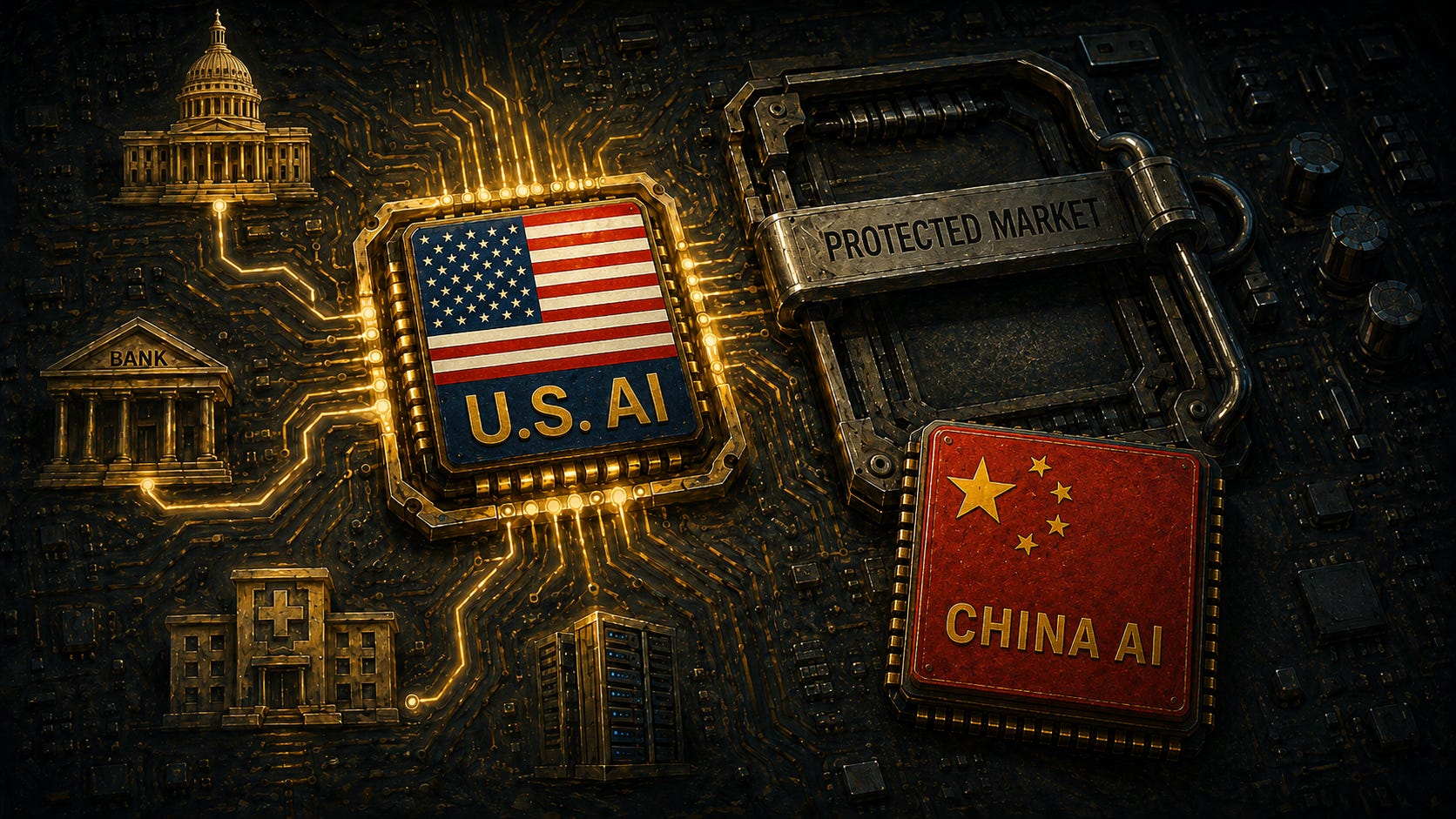
It appears that Washington is inching closer to taking action against Chinese AI influence in the United States. However, it remains undecided about what that action should look like.
U.S. officials appear to be engaged in an intense debate over what restrictions should be imposed on Chinese developers accused of intellectual-property theft, illicit model extraction, and export-control violations. Pushing in one direction are American AI companies seeking a stronger response to the influx of lower-cost Chinese models. Meanwhile, Nvidia, Microsoft, Meta, IBM, and other technology companies have warned that overly broad restrictions could undermine open-model competition and weaken the broader American technology ecosystem.
We are approaching a critical inflection point. Low-cost Chinese models have not fundamentally displaced American providers across most of the U.S. market, but concern is beginning to take hold among influential political and economic actors. The question is what it would mean for increasingly capable and inexpensive Chinese models to flood the market.
Many major enterprises, government agencies, and regulated industries have legitimate reasons to prefer American AI providers. These include security concerns, access to customer support, and uncertainty about model provenance, particularly when sensitive commercial information, trade secrets, and proprietary products are involved.
But what can Washington realistically do?
There is a practical enforcement problem. Open-weight models are not Huawei telecommunications equipment physically installed inside a network. Their weights can be downloaded, copied, modified, incorporated into another system, or hosted entirely on American platforms. Removing them from the broader private market would be both disruptive and difficult to administer.
A complete shutdown is therefore unlikely. The more plausible outcome is that Chinese models remain available in the open market while being excluded from government work and from sensitive systems or sectors in which customers spend heavily and tolerate little regulatory uncertainty.
The United States does not need to decide that every small Chinese model presents an immediate threat before drawing such a boundary. Procurement rules, contractor requirements, and security standards could narrow where these models may be used without Congress imposing anything resembling a comprehensive commercial ban.
The question now is whether Washington will continue targeting only the Chinese companies developing these models or begin requiring American businesses to avoid them.
What to Watch
Right now, the debate appears to revolve primarily around Chinese developers.
Washington is considering whether to use sanctions, export controls, and the Commerce Department’s Entity List against Chinese AI companies. According to Reuters, DeepSeek and more than 100 other companies had been approved by an interagency committee for possible addition to the Entity List, but the Commerce Department had not published the additions as the administration sought to avoid escalating tensions with Beijing.
The allegations surrounding Chinese developers extend beyond ordinary commercial competition. American officials and AI companies have raised concerns that Chinese firms have obtained restricted advanced chips and attempted to extract capabilities from leading American models.
Entity List treatment would make it considerably harder for targeted Chinese developers to obtain American goods, software, and technology. It would not, however, prevent American businesses from using model weights that have already been released.
Preventing that use would require a significant shift in responsibility. Instead of focusing on what Chinese developers may obtain or sell, Washington could place the burden on American commercial interests by prohibiting them from using certain models or requiring those models to be ring-fenced from specified commercial activities.
Many readers may remember the United States’ efforts to contain Huawei’s influence both domestically and worldwide. The federal government initially prohibited agencies from purchasing systems that used covered telecommunications equipment. Section 889 later prevented agencies from contracting with entities that used covered equipment elsewhere in their operations, even when that use was unrelated to the federal contract.
This principle is expressed explicitly in Federal Acquisition Regulation 4.2102, which states that the prohibition applies regardless of whether the covered telecommunications equipment or services are used in performing work under a federal contract.
Under that approach, Huawei exposure was no longer merely a question of what the government purchased. It extended deeply into a private company’s own technology choices, creating a Faustian bargain: keep the technology and jeopardize eligibility for federal business, or remove it to preserve access to government contracts.
The implementation of an AI version of this rule would be the development worth watching most closely. Federal contractors might be required to identify restricted models embedded in their products or used by subcontractor systems. This type of tracking could quickly expand, transforming a narrow prohibition connected to a single federal project into a company-wide audit.
Applying a similar approach to regulated industries could broaden the effect further, although it would involve considerably more caveats. It would be difficult for banking, healthcare, energy, and telecommunications regulators to impose a clean prohibition. Instead, regulators might require companies to explain why their use of a foreign model is consistent with cybersecurity, third-party-risk, and operational-resilience obligations.
Under a targeted approach, a model would not need to become formally illegal. Its use could become commercially impractical if companies were repeatedly required to defend that choice to regulators, auditors, insurers, and federal customers.
How to Read This
How should we evaluate Washington’s future moves?
The significance of each step depends on who must comply and how far the obligation reaches.
Stage One: Government-System Restrictions
At the first stage, the government determines what may be installed on its own systems.
Section 6604 of the Intelligence Authorization Act for Fiscal Year 2026 requires the Director of National Intelligence to develop standards and guidelines for removing the DeepSeek application, or a successor application or service, from national-security systems operated by an intelligence-community element, a contractor to such an element, or another entity acting on its behalf.
The law reaches contractor-operated national-security systems, but it does not regulate a contractor’s unrelated use of Chinese AI elsewhere in its business.
That distinction is critical. Washington has restricted DeepSeek within a defined government-security environment, not across the wider American commercial market.
Stage Two: Federal-Contract Performance
At the second stage, contractors could be prohibited from using a listed model while carrying out federal work, supporting a federal contract, or handling government information.
Proposals under consideration would move in this direction by connecting restrictions on DeepSeek to federal-contract performance rather than to a contractor’s company-wide operations.
This stage would create a direct business cost, but companies could still comply by separating federal projects from their other systems.
At present, Washington has restricted DeepSeek on certain intelligence-community systems and considered extending restrictions to ordinary federal-contract performance. It has not yet crossed the Huawei line.
Current law does not generally make a contractor’s unrelated use of Chinese AI relevant to whether that company remains eligible for federal business.
The legal mechanism Washington chooses next therefore matters. Sanctions, export controls, and Entity List treatment would continue targeting Chinese developers. Contractor-wide restrictions would reach American users.
That choice will determine whether the policy remains another U.S.-China technology dispute or begins changing the structure of the American AI market.
Stage Three: Contractor-Wide Certification
This would be the first major shift.
A law or regulation could require contractors to certify that restricted models are not used elsewhere in their operations, embedded in their products, or relied upon by their suppliers.
Companies might then need to conduct extensive software audits, review vendors, trace model origins, and replace systems that are difficult to verify.
One important caveat is that an AI version of Section 889 would be more difficult to administer than the Huawei rule. A company can ordinarily identify the manufacturer of a router or surveillance camera. The ancestry of an AI model is less obvious.
A Chinese base model might be fine-tuned by an American business, incorporated into another product, transformed into a new model, or hosted entirely inside a domestic data center.
Untangling this complex web and converting it into an enforceable law would be difficult. Regulators would have to decide whether a model’s nationality depends on its original developer, its weights, corporate control, training methods, hosting location, or some combination of those factors.
Those decisions could place significant burdens on commercial entities. At this stage, definitions would determine whether the rule remained narrow or evolved into an expensive compliance regime.
Stage Four: Regulated-Industry Adoption
If Washington continues down this path, the protected enterprise market may begin adopting similar standards, either voluntarily or under regulatory pressure.
Regulators could impose requirements directly. Companies might also act independently after determining that the savings offered by a cheaper model are not worth the accompanying legal and operational uncertainty.
What remains unclear is whether the private market would close altogether or divide into two segments: customers free to experiment with inexpensive models and customers effectively limited to a smaller group of trusted providers.
The White House’s National Security Presidential Memorandum 11 provides one possible pathway toward deeper federal involvement in AI assurance and procurement.
NSPM-11 directs the national-security enterprise to establish close partnerships with industry, accelerate the adoption of advanced AI, maintain rigorous oversight, and implement security, testing, evaluation, validation, and verification measures. It also calls for partnerships with private companies to protect advanced American AI technologies from threats such as malicious model-distillation attacks.
The memorandum does not prohibit Chinese models or establish rules for ordinary private-sector use. However, it expands the federal government’s role in determining what secure and dependable AI deployment should look like within the national-security enterprise.
Standards initially developed for national-security use could eventually influence contractors, regulated industries, insurers, auditors, and other institutions that prefer to follow federal security expectations.
Why This May Stop Here
There are good reasons Washington may never move beyond the first two stages.
Cheap, open models currently benefit large portions of the American technology industry. Cloud providers earn revenue from hosting them, while chip companies benefit when additional models consume computing resources.
Nvidia, Microsoft, Meta, IBM, and other companies have warned that premature restrictions could suppress competition, drive innovation overseas, and surrender economic advantages to foreign competitors.
There is also tension within the federal government’s own AI strategy. Washington wants secure and trustworthy systems, but it also wants rapid adoption, access to multiple vendors, and less dependence on any single provider.
A contractor-wide prohibition could conflict with those goals by narrowing the market and concentrating government and enterprise demand among a small number of large American platforms.
Bottom Line
The easy conclusion is that restrictions on Chinese AI would benefit American AI companies. However, the effects would not be uniform.
A protected market would favor providers capable of offering strong models alongside secure hosting, audit trails, testing, contractual protections, and sufficient scale to satisfy federal or industry-specific requirements.
Those demands could strengthen the largest integrated American cloud and model platforms. Smaller domestic providers, however, might not benefit equally from that protection.
The advantage would likely be top-heavy. If compliance becomes expensive, rules intended to exclude Chinese competitors could also raise the cost of entry for American startups.
The more important knock-on effect may involve pricing.
Chinese models could continue lowering the cost of AI in consumer applications, software development, and smaller-business deployments. Their influence over enterprise pricing, however, would weaken if government contractors, banks, hospitals, and critical-infrastructure companies could not realistically use them.
The cheaper competitor would remain available without exerting the same downward pressure on prices throughout the entire market.
Editorial note: Laws of Capital analyzes litigation, regulation, settlements, and commercial incentives using publicly available information. Any stated probability or confidence level applies only to the scenario described and may change as new facts emerge. Nothing here is a prediction of share price, financial performance, transaction outcome, or final legal result, and nothing is legal, financial, or investment advice or a recommendation to buy, sell, hold, or trade any security.